
The printing industry employs multiple complex processes to ensure the production of high-quality paper products; several of these processes center on maintaining a conducive printing environment, as this sector faces several unique technical challenges, including the optimization of resource and energy utilization.
DCA offers Dehumidifiers in two basic air flow configurations, horizontal and vertical. Each has its advantages and normally the size of the equipment room and/or the orientation of the ductwork dictates which is preferred especially if this is a replacement dehumidifier.
Normally a horizontal dehumidifier replaces an existing horizontal dehumidifier and the same is true for a vertical dehumidifier.
In general a vertical dehumidifier normally sits on the floor and has a slightly smaller footprint, than a horizontal dehumidifier, but is much taller. A horizontal dehumidifier can set on the floor or be suspended in a mechanical room. Horizontal dehumidifiers also have the advantage of having the discharge air flow configured to be straight thru, bottom or top.
Proper humidity levels are essential for maintaining optimal air quality in a grow room, but efficiently monitoring and managing these levels can be challenging.
Indoor swimming pools are ubiquitously known to enhance any home, hotel, or hospitality business by providing a sense of relaxation and comfort no matter what the season. However, all pool owners also understand the high level of maintenance required to keep any pool in optimal condition -- including regular oxidations,vacuuming, and filter maintenance, even during the colder months.
At the Dehumidifier Corporation of America (DCA), our engineers frequently come across pool room dehumidification systems that have not been consistently or effectively maintained.
High turnover is common among pool room maintenance personnel — particularly in hotels, motels, and other hospitality-industry facilities — but to ensure optimal safety, performance, and longevity, it’s essential to establish a comprehensive dehumidification system maintenance plan that adheres to manufacturer recommendations.
In order to remain functional, comfortable, and safe, swimming pool areas must be equipped with high-quality, reliable dehumidification systems. As with any complex system, pool room dehumidification equipment requires regular maintenance and, periodically, replacement.
Determining whether replacement is the appropriate action, however, can be daunting or confusing, as diagnosing problems is often a complex process in itself. And once system issues have been identified, an operator must determine which course of action will best rectify them: repair, retrofit, or complete replacement.
Although dehumidifiers are built to endure harsh environments, the average lifespan of a dehumidifier used for industrial and institutional applications is nine to eleven years. It is typically more expensive to keep an aging unit instead of simply replacing the dehumidifier altogether.
At Dehumidifier Corporation of America, we can easily replace an obsolete dehumidifier. With the help of our team of experts, we can help you choose the exact replacement dehumidifier you’re looking for based on your requirements.
Vertical farming is an agricultural method in which crops such as leafy greens and herbs are farmed indoors within climate-controlled environments. As the process becomes more efficient and economically viable, these urban farms are becoming more prevalent across the United States.
By controlling important environmental factors indoors, growers are able to cultivate better-quality crops at higher yields and in shorter periods of time. This also reduces the human footprint on the environment, as water and nutrients are conserved and less pollution and emissions are generated.
Whether using dehumidification for industrial, commercial, residential, or swimming pool applications, customers must determine, if applicable, which of the two typical cooling system options will be the best fit for their application — air cooled or water cooled.
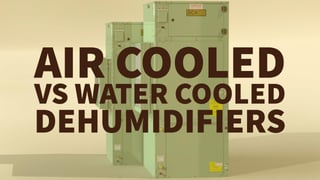
Air cooled dehumidifiers, for indoor pool room dehumidification and other projects, are the most common type and deliver warm dry air back to the space when operating. When room cooling is needed they are coupled with an optional outdoor remote condenser. This allows them to deliver warm dry air or cool dry air depending on what the controls call for.
Humidity is a major concern for all indoor swimming pool owners. Air-to-air heat exchangers and ventilation systems were commonly used to control pool room humidity.
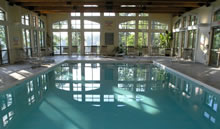 These methods are expensive to operate and wasteful, in that they constantly exhaust previously heated or cooled air outdoors. They also often fail to prevent structural damage caused by excess moisture, as the formation of mold and mildew in cold walls can cause irreparable damage.
The most effective way to control pool room humidity is to use a full dehumidification system that serves to remove destructive moisture and add room heating as a by-product of the dehumidification cycle.